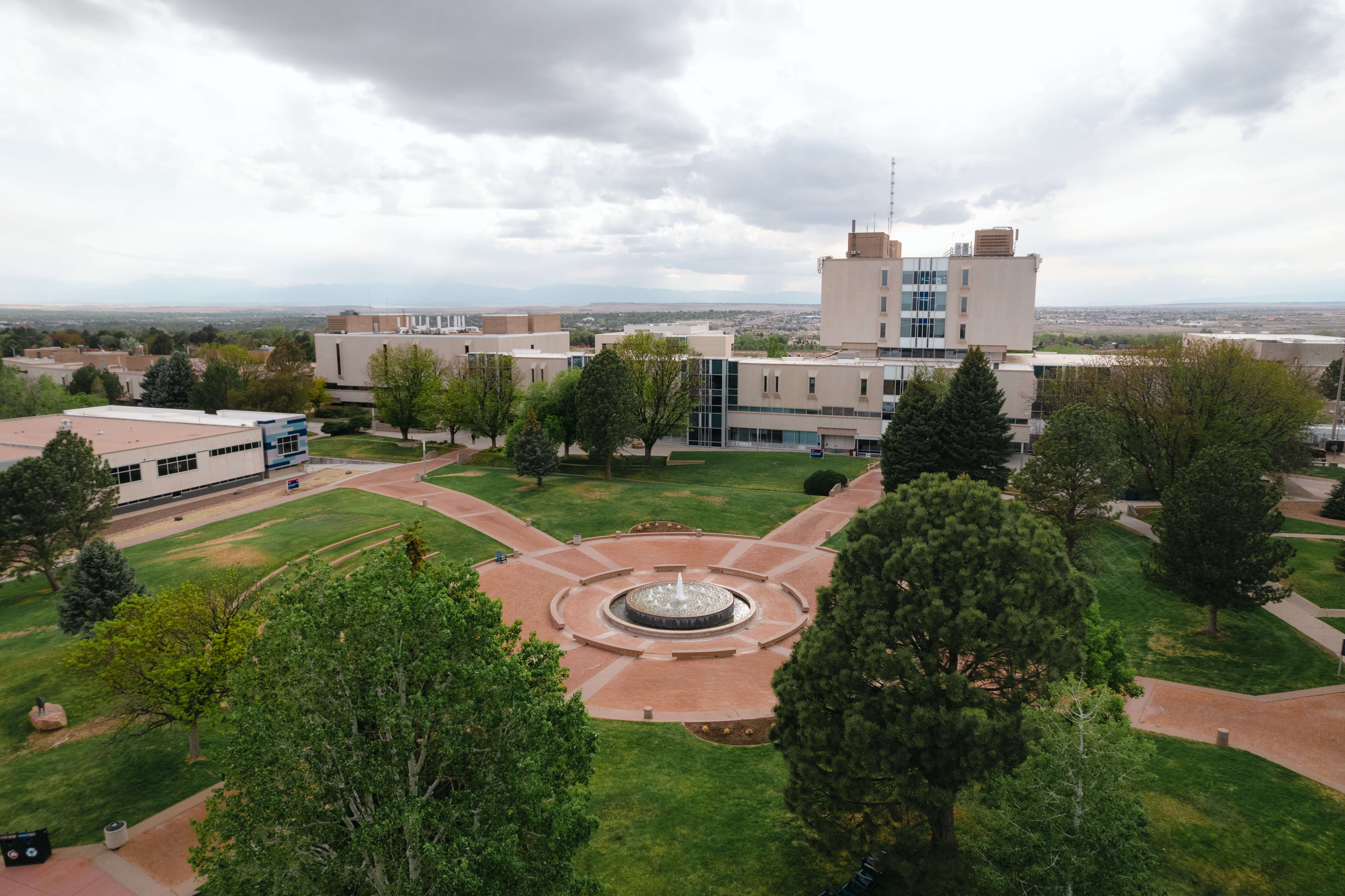
As morning light filtered through the buildings of Colorado State University Pueblo this Thursday, stories were being shared in the basement of the Occhiato Student Center. The stories were meant to provide a thread connecting the past to the present. A space to recall one of the darkest chapters of human history. The Holocaust, though painful to some, remains not as distant history confined to textbooks, but as lived experience carried in by the survivors and their descendants who still walk among us.
Thursday, April 24, 2025, marked the university’s twelfth consecutive year hosting Holocaust Remembrance Day events, aligned with the National Day of Remembrance designated by Congress. In an era when Holocaust literacy continues to decline across America, the significance of this day-long commemoration takes on renewed urgency.
Morning Session: Personal Testimony
The day began with a powerful personal testimony from Helena Atlas-Acuna, a Pueblo community member whose parents, David and Sally Atlas, survived the Holocaust. Atlas-Acuna opened Thursday’s events by sharing her family’s story, continuing her parents’ legacy by ensuring their experiences are not forgotten.

“We need to remember, especially in these times since Oct. 7, we need to remember this can’t happen again, and by George, it just did,” Atlas-Acuna said.
In her testimony, Atlas-Acuna recounted her parents’ harrowing journey. They married in 1938, and in ’39, Hitler invaded Poland. Her parents lived in South Poland, where the word was already getting out that they were “rounding up Jewish men, lining them up and shooting them down in various ways.”
Her father escaped with his brothers and a brother-in-law across the border to what is now Ukraine, then part of the Soviet Union. “They were immediately arrested by the Soviets, because the Soviets didn’t want you to run from the Nazis they wanted you to keep them away,” Atlas-Acuna explained. “They spent a couple of years in the Soviet labor camp until the Soviets signed a mutual defense pact with Poland, and then they let everybody go.”
Her mother faced her perilous situation. “They rounded up the women probably about a year later, maybe less, and if you were physically fit, and you had a skill, they sent you to forced labor, but they had like age requirements,” Atlas-Acuna recounted. “The word got around about, and my mother lied about her age, said she was six years younger than she was.”
A particularly moving moment during the morning session came when Atlas-Acuna shared Martin Niemöller’s powerful poem “First They Came.” The poem reflects on the rise of Nazism and the Holocaust, highlighting the danger of silence in the face of injustice:
First they came for the socialists, and I did not speak out—because I was not a socialist.
Then they came for the trade unionists, and I did not speak out—because I was not a trade unionist.
Then they came for the Jews, and I did not speak out—because I was not a Jew.
Then they came for me—and there was no one left to speak for me.
The poem’s core message stayed with those in the room: when people stand by while others are persecuted, the persecution will eventually spread to include them. As one attendee later noted during discussions, it serves as “a call to action, urging individuals to speak out and resist injustice, even when it doesn’t directly affect them.”
Afternoon Session: Expanded Perspectives
The afternoon featured Professor Laura Gribble from CSU Pueblo Psychology/Social Work department, who examined the often-overlooked persecution of LGBTQ+ individuals and people with disabilities during the Nazi regime. Her presentation shed light on how these vulnerable populations faced systematic targeting and elimination.
Gribble highlighted the history of eugenics policies. “Eugenics has a horrible, horrific history,” she explained. “A common misconception is that it started in Germany with Hitler… but it started (in America) with us. We were the ones who inspired, and we enacted it here.”
She detailed how forced sterilization targeted populations with disabilities, particularly those from ethnic and racial minorities. “Women of color are three times more likely to undergo legal sterilization than their white counterparts,” Gribble noted, explaining that these were “sterilization laws without consent of the individual.”
Gribble also talked about the Nazi’s Aktion T4 program, which led to the development of gas chambers. “What they did, or what was happening is that after they would exterminate them, they (the bodies) would either be ushered to dissection for further study or ushered into cremation, and the townspeople would complain about the smokestacks in their communities,” explained Gribble.
Attendees also learned about Josef Mengele’s horrific experiments on twins and other victims from organizer Dr. Pam Richmond in the department of social work. She explained how unethical experiments like Mengele’s and others led to the development of ethical research standards and the creation of the Institutional Review Boards (IRBs) to prevent such atrocities from happening in the name of science.
A Day of Reflection and Action
The day continued with Dr. Krista Bridgmon addressing post-traumatic stress and the Holocaust, while Rabbi Birdie Becker led a memorial service accompanied by Dr. David Volk’s musical tribute. Attendees also had time for quiet reflection, exploring children’s and adolescent literature alongside poster displays prepared by CSU Pueblo’s Teacher Education department.
As the day concluded with Dr. Grant Weller presenting the documentary “Night and Fog,” followed by a discussion, participants could reflect on the words of Elie Wiesel, “For the dead and the living, we must bear witness.” Before he died in 2016, Wiesel dedicated his life to ensuring humanity would never forget the atrocities he endured. His words, “To forget the dead would be akin to killing them a second time,” served as the philosophical underpinning for the day’s events.
The decline in Holocaust knowledge continues to alarm educators and survivors alike. A 2020 Pew Research Center survey revealed that only 69% of American adults could accurately identify when the Holocaust occurred. Less than half knew how many Jews were killed, and even fewer understood how Adolf Hitler rose to power. These statistics haunted many participants at CSU Pueblo’s commemoration.
As a Hispanic Serving Institution, CSU Pueblo’s commitment to Holocaust remembrance aligns with its broader mission of cultivating respect and understanding across differences. Dr. Richmond framed this mission poignantly: “I am saddened by the loss of millions of lives, horrified by the immense hatred against individuals perceived as different, and perplexed at the inability of people to recognize propaganda and strive to advocate for the oppressed.”