These Students Are Taking Pueblo’s Engineering Program to an International Stage
Three Industrial Engineering students from CSU Pueblo are heading to Texas in May to present original research on disaster recovery and logistics resilience at one of the largest professional conferences in their field.

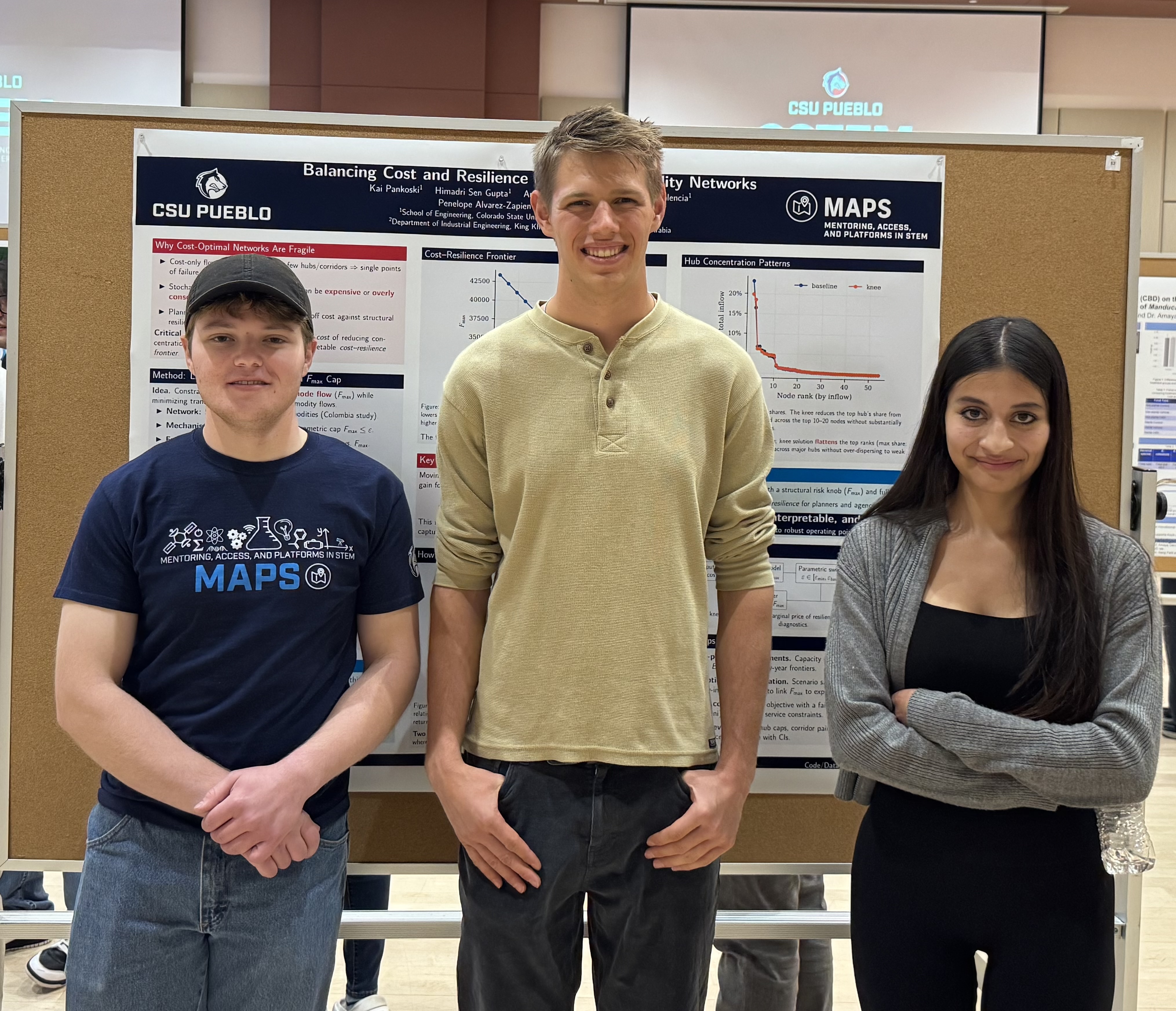
From left: Ammon Cash, Kai Pankoski, and Penelope Alvarez-Zapien at the 2025 CSU Pueblo Fall Research Symposium, where they presented early findings from their ongoing engineering research. Photo courtesy of Himadri Sen Gupta.
Most undergraduates spend their first years in engineering learning the tools. Kai Pankoski, Ammon Cash, and Penelope Alvarez-Zapien have been using them to solve actual problems, and in May they will take that work to Arlington, Texas, to present in front of engineers and researchers from around the world.
All three are Industrial Engineering students at Colorado State University Pueblo. Their research was accepted for presentation at the IISE Annual Conference and Expo 2026, scheduled for May 16 through 19. IISE, the Institute of Industrial and Systems Engineers, is the major professional society in the field. Submissions go through a formal peer review process, and the conference draws researchers, practitioners, and students from across the globe.
The students are working on two separate but related projects, both under the mentorship of Himadri Sen Gupta, assistant professor in the School of Engineering, and Leonardo Bedoya-Valencia, associate professor in the School of Engineering. The research is supported by the STEM MAPS Program and Discovery Scholars Program, which have provided ongoing backing for student engagement in STEM at CSU Pueblo.
“My research project has allowed me to see the wide variety of applications that operations research has, and has allowed me to develop analysis skills I hope to apply throughout my education and career.”
Kai Pankoski, Industrial Engineering studentThe project heading to IISE is titled Balancing Cost and Resilience in Multi-Commodity Networks. The core question it asks is deceptively practical: how do you design a transportation or logistics network that stays functional when something goes wrong, without making it so expensive it becomes unrealistic? It is a tension planners deal with constantly. The team developed an optimization framework that offers a kind of adjustable dial, letting decision-makers weigh cost efficiency against structural vulnerability based on what a given situation requires. The model was tested using real network data from a national-scale logistics system in Colombia, though the approach is built to generalize. Wherever there is data, the framework can follow. The project also grew from a collaboration with Osamah Moshebah, an assistant professor at King Khalid University.
For Sen Gupta, the project has a personal dimension. It was the first research initiative he launched after joining CSU Pueblo in fall 2025, shortly after completing his PhD in Industrial and Systems Engineering at the University of Oklahoma. Watching students take that early work and carry it into an international venue has been, in his words, genuinely rewarding.
Also in Progress MAPS & Discovery Scholars
A second project, Data-Driven Prioritization for Post-Disaster Food Access, is still in development and not yet submitted for publication. Using data gathered after Hurricane Harvey, the team is building models to help emergency planners decide which retailers should receive limited recovery resources first, with the goal of restoring food access as quickly and as equitably as possible.
This work is being developed into journal papers and is part of a broader funding proposal in collaboration with the University of Texas El Paso. The disaster food access project has not yet been presented publicly, but it is a significant piece of the team’s longer-term research agenda.
What drew the students to this kind of work, according to Sen Gupta, was the chance to see Industrial Engineering tools land somewhere real. Optimization and data modeling are not abstract concepts in these projects. They connect directly to decisions that affect communities after disasters, or to the logistics networks that keep goods moving when conditions are difficult. That framing, IE methods applied to actual societal problems, shaped how the team approached both projects from the start.
The School of Engineering has been building this kind of research culture incrementally, and this moment is a clear sign that students here are ready to participate in it at a high level.