
The Trifecta
Three friends. Four years. One point short. And a bond that research says will shape the rest of their lives.
The final buzzer sounded in Spearfish, South Dakota, and CSU Pueblo’s season was over by a single point. Colorado Mesa had advanced and the Thunder Wolves were heading home, one basket short of the RMAC tournament final. For most players on that roster, it was the kind of loss that stings for a few weeks and then fades into the background of a life that moves on. For three of them, it was something else entirely. It was the last game they would ever play together.
This week, March Madness tips off across the country, and the spectacle it brings swallows everything else in the sports calendar. Brackets fill offices and group chats. Division I programs play out the climax of their seasons under national television lights. A division below all of that, in the Rocky Mountain Athletic Conference, a quieter version of the same story already concluded. But the story worth telling isn’t necessarily the one with the biggest audience.
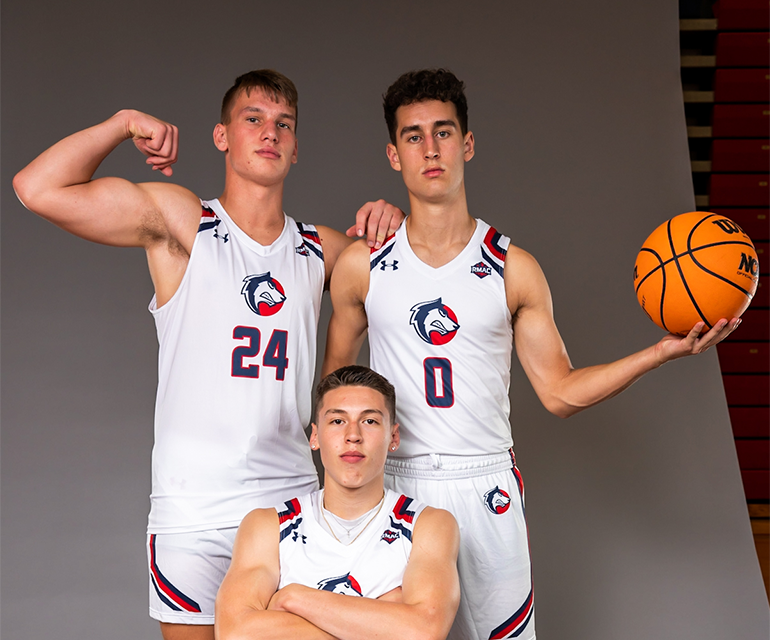
Sam Howary, Landon Dvorsky, and Andon Mindrup are all from Colorado Springs, all seniors, and all members of the CSU Pueblo men’s basketball class of 2025. They have been friends since middle school. They played club ball together, went to high school together, and then, in a move that is increasingly unusual in college athletics, they all committed to the same university and played there for four consecutive years without any of them transferring. They call themselves the Trifecta.
“It sucks because we feel like we fell short. But it was also like, man, we had a ton of firsts for everything. Our coach laid out all the firsts that this season had and we’re like, ‘Oh, snap.’ We didn’t even realize it was all like that.”
Landon DvorskyThe friendship between these three is more than a loyalty story. Research on early social bonds shows that the quality of childhood and adolescent friendships carries measurable consequences well into adulthood. Early life conditions account for differences in health trajectories in later life, as disadvantages in childhood often lead to disadvantaged outcomes in adulthood. Research also showed that children who lack friends and who do not feel connected to their peers are at greater risk of poor adult health compared with children with stronger friendship bonds. A study published in The Gerontologist found that adverse childhood friendship experiences were significantly associated with both lower initial cognitive functioning and a faster rate of cognitive decline in later life, with effects that persisted even after accounting for adult loneliness and social disconnectedness (Burr, Han, & Peng, 2020).
Burr JA, Han SH, Peng C. Childhood Friendship Experiences and Cognitive Functioning in Later Life. The Gerontologist. 2020;60(8):1456–1465. PMC8243266 · Caspi et al., 2006 · Kobayashi et al., 2017The Trifecta didn’t form because someone ran a study. They formed the way most real friendships do, through proximity, repetition, and the particular bond that comes from competing alongside someone at an age when everything feels like it matters more than it probably does. But what they built, and what they chose to preserve through four difficult years of college, is exactly the kind of sustained peer connection that researchers point to when they talk about the long arc of a well-lived life.

It starts in a gym nobody remembers. Club ball, middle school, Colorado Springs. A lot of kids who play club sports go on to play in college, and some of them are good enough to earn a roster spot somewhere. But playing with the same people all the way through, from junior tournaments to college basketball, is genuinely uncommon. By the time players are weighing scholarship offers and portal decisions, the math of individual advancement almost always overrides the pull of shared history.
At higher levels of college athletics, it rarely happens at all. Scholarships create their own gravity. A player who can compete at Division I doesn’t stay at a Division II program out of loyalty, and a player who can earn a better offer elsewhere doesn’t usually turn it down to stay with friends. The incentive structure pushes everyone toward the best individual outcome, which is a reasonable and understandable thing to want. It just means that what Howary, Dvorsky, and Mindrup did is increasingly rare, and worth paying attention to.
Players who’ve spent years together on the court develop a kind of shorthand that’s difficult to teach and impossible to install in a preseason. You know where your guy is going before he knows he’s going there. That familiarity shows up in ways that don’t always appear in the box score, in the pass thrown to a spot before the cutter arrives, in the defensive rotation that happens a half-second faster because someone already knew what was coming. Coaches at the highest levels spend millions building systems designed to replicate what these three developed simply by growing up together.


Committing to CSU Pueblo made sense geographically since Colorado Springs to Pueblo is a short drive, and they were already connected. But what came after was harder than any of them expected. A previous coaching staff made things difficult, and the relationship with those coaches wore on all three of them. Dvorsky dealt with hip dysplasia. Mindrup had two knee surgeries. There were long stretches where playing time was thin and the whole enterprise felt more like endurance than development.
“There’s definitely been times where I was like, all right, I’m ready to be done. And I mean, being able to lean on them, we had plenty of conversations, plenty of talks, and just it’s one more year, stick through it. And I mean, personally, I’m so excited that I did.”
Andon MindrupThe transfer portal has made leaving easy, and plenty of players have done it for far less reason. The logic is almost always individual: what’s best for me, what level can I reach, what school offers a cleaner path forward. That calculation makes sense and it isn’t wrong. It’s just that it’s a single-person calculation, and what these three were doing was something different. They were making a group decision, one more year at a time, until four years had passed and they were seniors.
“I think honestly, our friendship kind of stuck us here and kept us together.”
Landon Dvorsky
Game day. Four years of this walk. They knew where they were going long before they got there.
A new coaching staff arrived and the experience of playing basketball changed. Preparation became more detailed, with practices built specifically around upcoming opponents and scouts that gave the players a clearer picture of what they were walking into each night. It was the kind of environment where familiarity between players becomes an asset rather than a coincidence, because players who already trust each other absorb a system faster and execute it with less friction.
The results came. They beat Colorado School of Mines for the first time since 2018. They hosted a playoff game. When the coach read the full list of program firsts from the season aloud, the players were genuinely surprised by how long it had gotten. The list was longer than any of them realized they were building.
None of it made losing by one point in the semifinals easier to absorb. A one-point loss is not a team that got outclassed. It’s a team that was right there and then wasn’t.

The benefits of what these three built didn’t stop at basketball. They were suite mates in the dorms before moving into an apartment together. They talked each other through injuries, through bad coaching situations, through the moments when it seemed easier to leave than to stay. That kind of sustained social support, maintained over years and across both easy and hard circumstances, is precisely what the research on friendship and health points to as meaningful. It’s not just about having people to spend time with. It’s about having people who know your full history, who have watched you fail and recover, and who are still around when the next thing goes wrong.
The academic dimension of their college experience was shaped by this too. Having people who knew what you were carrying day to day, who could hold you accountable to showing up, who could tell the difference between a hard week and a real problem, is a different kind of resource than any campus service can offer. It’s peer support in the oldest and most effective sense of the term, and it worked.
After graduation, Mindrup is moving to Florida to build a career in finance. A new city, a life that doesn’t revolve around a basketball schedule. Howary and Dvorsky are staying on as graduate assistant coaches, which means they’ll be on the other side of the huddle now, holding clipboards instead of balls, figuring out how to teach something that mostly gets learned by doing.
“We won’t be playing on the court, but we’ll be a part of the team. It’ll just be a different perspective.”
Landon DvorskyA former teammate used to call them the Three Musketeers until they came up with their own name. The Trifecta. Whatever comes next, for all three of them individually, it will be shaped in some way by what they built together over the better part of a decade. The research says so. And so does what they already know.
“It’s even cooler the fact that we were able to stick it out all four years and stay together throughout the whole process.”
Sam Howary · CSU Pueblo, Class of 2025