
The Seat That Sends You Home
Samuel Moore graduated from CSU Pueblo in 2023 with a bachelor’s and master’s in mechatronics engineering and a minor in leadership studies. He builds ejection seats for a living. On March 1, six pilots over Kuwait owed their lives, in part, to his work.
Samuel Moore is up before the sun. By 4:30 a.m. he is awake, and by 6 he is on the operations floor at Collins Aerospace in Colorado Springs, running through the morning standup, accounting for every seat in every stage of its build. On any given morning, Moore might have three seats in progress at once, each at a different stage in the build, each one carrying the full weight of what it means to be the last thing between a pilot and death.
“I get to build something that saves someone’s life,” Moore says. “That’s not something I take lightly.”
Moore, 26, is a Senior Manufacturing Engineer in Collins Aerospace’s Mission Systems division, where he works specifically on ejection seat programs, including next-generation models for the F-15 and F-16 fighter jets. His job is meticulous and technical. He ensures that every seat leaving his facility is built to exact design specifications. He writes the work instructions that operators follow during assembly. He manages quality write-ups. He sits on design reviews to make sure that what engineers are drawing on a computer can actually be built by human hands on a floor. Nothing gets out the door unless it checks out.
He is not the one who touches the seats. But he is the one who makes sure the people who do have everything they need, and that the finished product is right.
On March 1, 2026, three U.S. F-15E Strike Eagle fighter jets were shot down over Kuwait during Operation Epic Fury, an operation targeting Iranian threats. All six crew members ejected successfully and were recovered in stable condition. The jets had been misidentified and struck by friendly fire from Kuwaiti air defenses during intense combat operations involving Iranian drones and missiles. It was a chaotic, split-second tragedy. And then, somehow, everyone was alive.
Moore walked into work on Monday and heard the news. Six ejections. All successful. The total number of lives saved by Collins Aerospace ejection seats rose to 727.
He describes the feeling as ecstatic. And then something quieter moved through it.
“I know that some of those pilots have kids,” he says. “They get to go home and hug their kids and their lives are now intact forever because of the product that comes out of this building.”
“The children whose parents were flying those jets, they get to see their mom and dad again. I think that’s beautiful.”— Samuel Moore, Senior Manufacturing Engineer, Collins Aerospace
Moore grew up in Pueblo. Born and raised. His mother is a nurse. His father is a schoolteacher. He describes them both as people who show up every day to do something that helps someone, which is, he says, the only kind of work he ever wanted. He just didn’t know what form it would take.

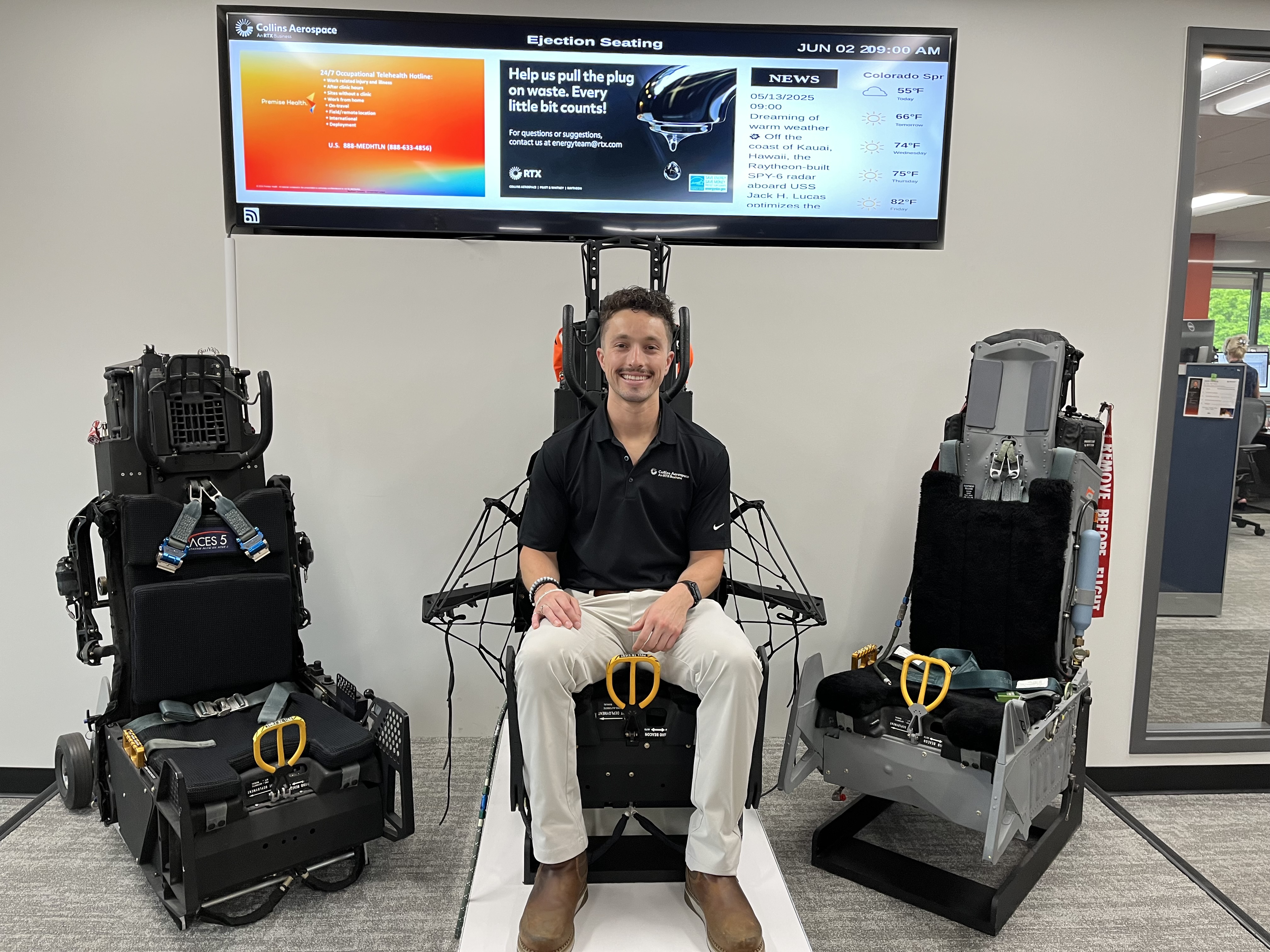
Moore at Collins Aerospace’s Colorado Springs facility, flanked by an ACES II ejection seat (right) and an ACES 5 ejection seat (left) — two of the programs he supports as Senior Manufacturing Engineer.
He enrolled at CSU Pueblo, choosing to stay close to home instead of heading to a bigger school up north or out of state. That decision shaped everything that came after.
“I sit in rooms with people that have degrees from all these giant universities,” Moore says, “but I have unique experience from being in the small classrooms at CSU Pueblo. I don’t think I would’ve survived in a big classroom setting like the ones they came from.”
What he means is that he needed the access. The extra office hours. The professors who had the time to sit with a student for hours, working through a problem until it clicked. Moore is straightforward about the fact that he was not a kid who things came easily to. He is a blue collar kid from Pueblo who put in the hours. He and his best friend practically lived on the third floor of the library, in a corner study room they called Big Bertha.
Moore completed CSU Pueblo’s 3+2 program, earning both his bachelor’s and master’s degrees in mechatronics engineering, the discipline that sits at the intersection of mechanical, electrical, and software engineering. He graduated in 2023. And he was a Kane Family Foundation Scholar and member of the President’s Leadership Program, minoring in leadership studies. A program he credits with developing the concision and professional skills that engineering coursework alone cannot teach.
“Being able to communicate and understand leadership styles and how to navigate different personalities and people in different job teams,” he says of what the program gave him. “That’s maybe the biggest piece of what I am now.”
The path to Collins didn’t start after graduation. It started earlier, when an adjunct professor named John Linck walked into Moore’s class. Linck, also an associate director of material science at Collins Aerospace’s Pueblo facility, mentioned almost in passing that students could apply for internships at the site. Moore applied. He got in, eventually, in his fourth year. He interned in 2021 and 2022, and graduated the following spring.
“I used to think aerospace engineering meant my degree said aerospace engineering,” Moore says. “But it actually means you’re working in aerospace as an engineer, because there’s billions of different engineering jobs in this world. You’d only know that if you were in it.”
He is in it now, in Colorado Springs, at one of the facilities of RTX, the parent company of Collins Aerospace, which he notes is larger by market than Boeing, Northrop Grumman, and Lockheed Martin. Every morning he walks in grateful.
Moore’s work on the ACES II and ACES 5 ejection seat programs places him inside a lineage of aerospace engineering that pilots have been trusting with their lives for decades. The ACES II has been in service since the 1970s and remains one of the most widely used ejection systems in the U.S. Air Force. The ACES 5 is the next-generation successor, designed for modern aircraft demands. Moore supports both. He is one of the people who makes sure the pyrotechnic sequencing, the structural tolerances, and the assembly specs are all exactly what they need to be.

An ACES 5 ejection seat on display at Collins Aerospace. The next-generation system is designed to expand the safe ejection envelope for pilots across a wider range of aircraft speeds and altitudes.
Not every day includes news that six people just survived because of your work. Most days it’s write-ups and standups and sitting with an operator who has a question. But the weight of the work is always present.
“Despite any political interest in being at war or whatever,” Moore says, “I know that I make something that will hopefully protect the life of an American or our allies.”
He says it plainly, without performance. He is a man of faith. He has sticky notes with scripture and quotes all over his cubicle. He has also been open about his sobriety, which he counts as one of the shaping forces of his character, the thing that taught him to face hard things head on instead of around them. He manages a chronic nerve condition that has required two surgeries in two years. He still runs. He lifts. He journals. He coaches youth basketball on the side.

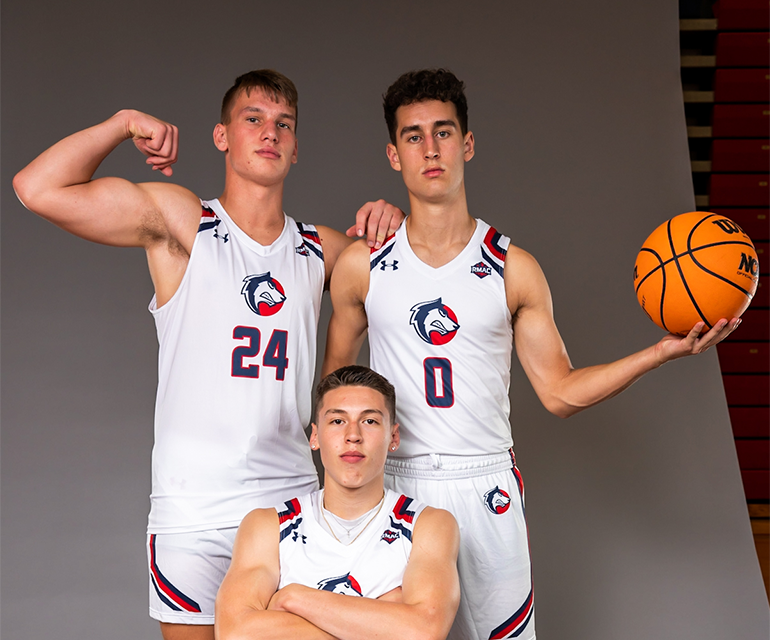
Moore celebrates a Metro Conference championship with his Dayton United youth basketball team. Outside of Collins Aerospace, Moore coaches youth sports as one way he stays connected to community and service.
He moved back to Colorado after a two-year rotational program took him around the country post-graduation. He wanted to be closer to his parents in Pueblo. That instinct, to be near the people who matter, is woven through everything he says.
The six pilots recovered in stable condition from the Kuwaiti desert. Their families got the call that everyone lived. Somewhere in Colorado Springs, a young engineer from Pueblo who wakes up at 4:30 heard about it on a Monday morning and felt something that he can only describe as beautiful.