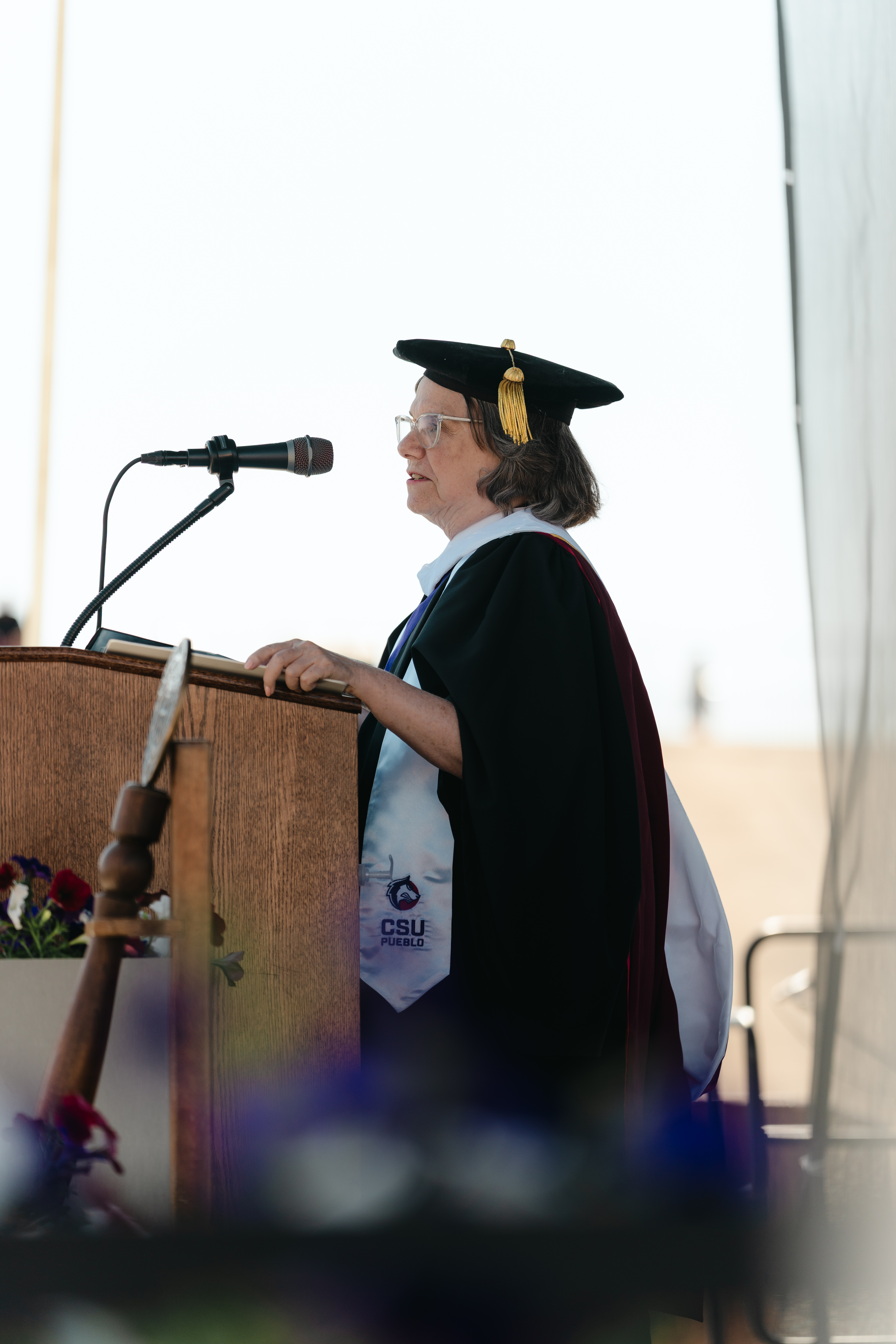
Catherine Bertini on What These Graduates Need to Know
The former United Nations World Food Programme leader brought a message about education, service and changing systems to CSU Pueblo’s Class of 2026.
Catherine Bertini woke up exhausted the morning she came to CSU Pueblo. She had been taking care of a sick friend and, at 76, traveling across the country. When asked why she was here, why she bothers with commencement speeches when she could be resting, she said it directly:
“Girls are the people who keep families together. They take care of children. They ensure children are educated, that their health is taken care of. With an education, they do that better.”
That is what she came to tell nearly 500 graduates sitting under the mid-morning sun at Thunderwolf Stadium on May 16.
For decades, Bertini has solved the problems that look impossible. The world’s bureaucracies are not built for speed. They are built for consensus and protection, with processes that take forever. She walked into the United Nations World Food Programme in 1992 and found an organization strangled by that.
The Berlin Wall had just fallen. The Soviet Union was collapsing. Conflicts were erupting across Eastern Europe and Somalia. People everywhere needed food. But WFP was still operating under another UN agency that moved at a glacial pace.
“Layers upon layers upon layers,” she said, remembering the bureaucracy. “It just took forever to make decisions.”
Rebuilding for Speed and Impact
Her predecessor had already fought to free WFP from that control. When Bertini arrived, the organization had just three months of independence. She rebuilt everything from scratch: IT systems, human resources and financial management.
She threw out the old infrastructure and designed new systems for speed, and for a world that was not waiting.
“We had to move as soon as possible,” Bertini said. “For the first few years it was challenging, but we worked it out and it runs today very smoothly.”
She spent 10 years there and won the World Food Prize for what she built. Bertini does not measure her legacy by the prize. She took every penny of her World Food Prize proceeds and put it into the Catherine Bertini Trust Fund for Girls Education.
Why Girls’ Education Matters
When you ask her why girls, why not the broader humanitarian crisis, she answers like someone who has watched the same pattern repeat across continents. An educated girl does not just change her own future. She changes everything after her.
She spaces her children better. She is more likely to send her own children to school. If she farms, she becomes a productive farmer. She knows how to count rows, handle suppliers and manage money.
“In almost every area,” Bertini said, “educated girl becomes productive and she makes all the difference.”
She has tested this principle against actual oppression. During the Taliban’s first control of Afghanistan, the UN had one bargaining chip: food assistance. Bertini’s organization said: feed schools only if girls get to attend.
When the Taliban said boys were more important, they responded: “Yes, boys are very important. So are girls. If you want food for boys, girls get fed too.”
This was her non-negotiable.
A Message for the Class of 2026
The graduates at Thunderwolf Stadium, many of them first-generation students and all of them facing a world that requires them to solve what looks unsolvable, heard her message Saturday morning.
It was not about saving the world with a perfect plan. It was about walking through the door you have been given, seeing what is broken and changing the systems. It was about understanding that the leverage point is often something small. Something human. A girl’s opportunity. A decision made quickly instead of decided by committee.
What Bertini came to tell the Class of 2026 is what her entire career has proven: these graduates are now part of the solution.
CSU Pueblo is training first-generation students to change things. And paying it forward is not something noble you do eventually. It is how the world works.
Catherine Bertini addressed CSU Pueblo graduates during Spring Commencement at Thunderwolf Stadium on May 16.