Inside the Walls: How CSU Pueblo Is Expanding Educational Access for Incarcerated Students
Through the Inside-Out Prison Exchange Program and Brink Literacy Project’s F(r)iction in the Classroom, CSU Pueblo and Extended Studies deliver college-level education inside Colorado correctional facilities—and the results reach well beyond the classroom.
Kaile Stevens did not write her reflection on a laptop. She wrote it by hand, on lined notebook paper, the way students inside correctional facilities do. Dated May 15, 2026, her words carry the kind of clarity that formal academic writing rarely achieves.
“This program offers a uniquely inspired path toward a transformed life. It provides a platform rooted in a common pursuit of knowledge, which culminates in our ability to begin adding value to a community we once took away from.”
Kaile Stevens — Inside Student, Spring 2026Stevens is one of the inside students currently enrolled in CSU Pueblo’s Inside-Out Prison Exchange Program at La Vista Correctional Facility. Her reflection arrived this spring alongside several others, each different in voice, but all carrying the same thread: education changes something. That is precisely what CSU Pueblo and its partners are counting on.
A Different Kind of Classroom
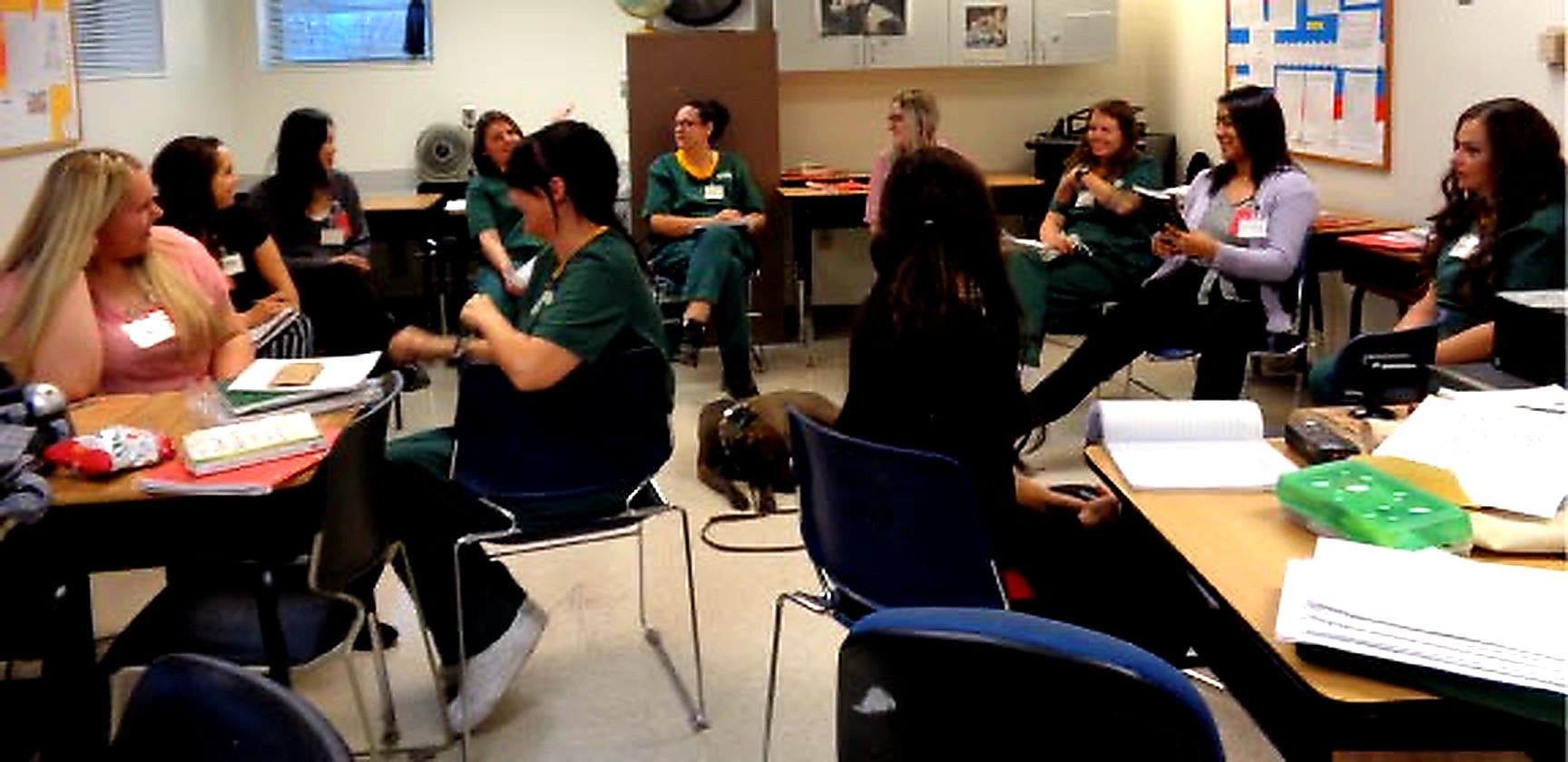
The Inside-Out Prison Exchange Program pairs CSU Pueblo students with incarcerated students to take college-level courses together inside the facility. The Department of Sociology, Criminology, and Anthropology has participated since 2017, when Dr. Colleen Hackett launched it at CSU Pueblo. Currently, six outside students and six inside students make up each cohort at La Vista.
There are no phones in the room. No notifications. For three hours, everyone is fully present with each other and the course material—something increasingly rare in any classroom.
Associate Professor Heidi Reynolds-Stenson completed her Inside-Out instructor certification in 2020 through the Inside-Out Prison Exchange Program Training Institute and has taught at La Vista since programming resumed after the pandemic. She teaches Understanding Lived Experiences, a course where students read memoirs and examine life stories—their own and others’—through a sociological lens.
“I am always amazed by the powerful learning that occurs for everyone—including me—when we bring incarcerated and non-incarcerated students together for these classes.”
Heidi Reynolds-Stenson — Associate Professor, Sociology, Criminology, and AnthropologyHer colleague Michael Briscoe, assistant professor in the same department, teaches Crime and Society in Science Fiction and Crime, Law, and Justice Studies. In both courses, students write original short stories built around sociological and criminological concepts. What would happen if bureaucracy required people to submit annual applications to keep living? What would a society look like if matriarchy replaced patriarchy? If names were reserved only for the elite and everyone else received a number? At the end of each semester, Briscoe compiles the stories into a printed book and gives every student a copy.
“It gives a special sense of ownership and pride for students to have their work published in a tangible book rather than just typed up, turned in, and forgotten.”
Michael Briscoe, PhD — Assistant Professor, Sociology, Criminology, and AnthropologyWith student permission, he has presented their work at the Southern Colorado Conference for the Humanities, Arts, and Social Sciences. This summer, he will bring it to the American Sociological Association’s annual meeting in New York.

What Students Are Saying
The testimonials from this spring’s cohort go beyond course evaluations. Inside and outside students describe something that extends well past content—a shift in how they see themselves and each other.
“Taking this class has motivated me to continue on to obtain my college degree. I learned that sharing my story helps others learn. I learned that I am resilient and open to growing and understanding other’s stories.”
Natalie Martinez — Inside Student“This class was more than just a college elective class. From the books to the topics, students and professor participation—this class is an experience. I am encouraged to further my education as a result of my experience.”
Emily Kirby — Inside Student“In a way this program has also allowed me to share and express my own trauma that it has healed some part of me. Reading the memoir books has changed and made me much more aware of the seriousness. I recommend this class because it is genuine, purposeful and helpful.”
Anonymous — Inside Student“Sometimes it is hard to cope with incarceration as one may at times feel stagnant. So having Inside Out Programs at our facility helped with our mental health as well. This class has given me purpose, direction, and motivation in life.”
Anonymous — Inside Student“In all of my college time—four years—these classes have been some of the most engaging ones. It brings back some of the beauty in human interaction. These classes are vital to what helps set CSU Pueblo apart from other universities.”
Gabe — Outside Student (3rd Inside-Out class)“This class overall allows an open conversation on top of learning more about why things happen. It allows for inside students to have a chance at learning and improving.”
Rachel — Outside StudentBeyond the Classroom: F(r)iction in the Classroom
Inside-Out is not the only program reaching incarcerated students through CSU Pueblo. Through CSU Pueblo Extended Studies, the university partners with Brink Literacy Project, whose F(r)iction in the Classroom program brings three creative writing courses into correctional facilities. Using F(r)iction, a nationally distributed literary journal, and original comic book curriculum developed specifically for the program, Brink teaches at Youth Offender Services and at La Vista Women’s Correctional Facility.
The program gives students access to serious literary work and asks them to produce their own—with the same rigor any writing student would bring to a university classroom.
About Brink Literacy Project & F(r)iction in the Classroom
Brink Literacy Project uses literature—including the award-winning journal F(r)iction and original comic book memoir curriculum—to teach creative writing in correctional facilities and community partner sites. Through CSU Pueblo Extended Studies, Brink currently runs three classes serving students at Youth Offender Services and La Vista Women’s Correctional Facility.
The Numbers Behind the Work
The case for prison education has been building for years, and the research backs it with hard figures. A 2023 meta-analysis by researchers at Middle Tennessee State University, published in the American Journal of Criminal Justice, reviewed 78 studies and 148 estimates on the effects of prison education programs—the largest analysis of its kind.
For every 1,000 inmates served by prison education and later released, between 70 and 150 fewer will return to prison than otherwise would. The financial case is equally clear. The Vera Institute of Justice calculates the average cost of imprisonment at $40,028 per prisoner per year, meaning each return to prison costs approximately $107,000.
| Education Type | Recidivism Reduction | Employment Increase | Return on Investment |
|---|---|---|---|
| Adult Basic Education | 6.3% | 1.5% | 104% |
| Secondary / GED | 7.2% | 1.2% | 122% |
| Vocational Training | 9.4% | 5.5% | 210% |
| College Education | 27.7% | 10.5% | 61%* |
*College programs carry higher per-student costs (~$10,467/year vs. ~$2,000 for other types), which lowers ROI despite having the largest impact on recidivism. Source: Schuster & Stickle, American Journal of Criminal Justice, 2023; RAND Corporation meta-analysis, 2014.
Access to funding has also expanded. In July 2015, the U.S. Department of Education launched the Second Chance Pell Pilot Program, making Pell Grants available to incarcerated individuals. As of July 1, 2023, that access became permanent—nearly 30 years after the original ban. College-level education, once nearly impossible to access behind bars, is now within reach for students like those enrolled at La Vista and Youth Offender Services.
A Workforce and Human Need
One former CSU Pueblo student who completed two Inside-Out courses emailed Briscoe after graduation to share that she had been offered a job at La Vista Correctional Facility. Others have enrolled in graduate programs in social work focused on serving incarcerated and formerly incarcerated people. The pipeline works in both directions.
“Whether you call it a workforce need or a human need or a societal need, we need more empathetic and critical thinking people who can resist and challenge that urge to write off entire groups of people. It doesn’t matter if someone ends up working in a criminal justice field, healthcare, or business. We need more of those kinds of graduates.”
Michael Briscoe, PhD — Assistant Professor, Sociology, Criminology, and AnthropologyEvery job application in criminology and criminal justice asks applicants about their experience with justice-impacted people. The Inside-Out program answers that question with 16 weeks of direct experience inside a correctional facility, CDOC training, and course content that demands students think differently about the criminal justice system and about each other.
CSU Pueblo’s goal is to be the people’s university of the southwest. Prisons are part of that landscape. Programs like Inside-Out and F(r)iction in the Classroom are how the university holds to that commitment, one classroom at a time.