the session.
Students Get a Look at How Investigators Solve Digital Crimes
A Pueblo County detective and a university instructor show students how careers in computer forensics take shape.
PUEBLO, Colo. — November 6, 2026
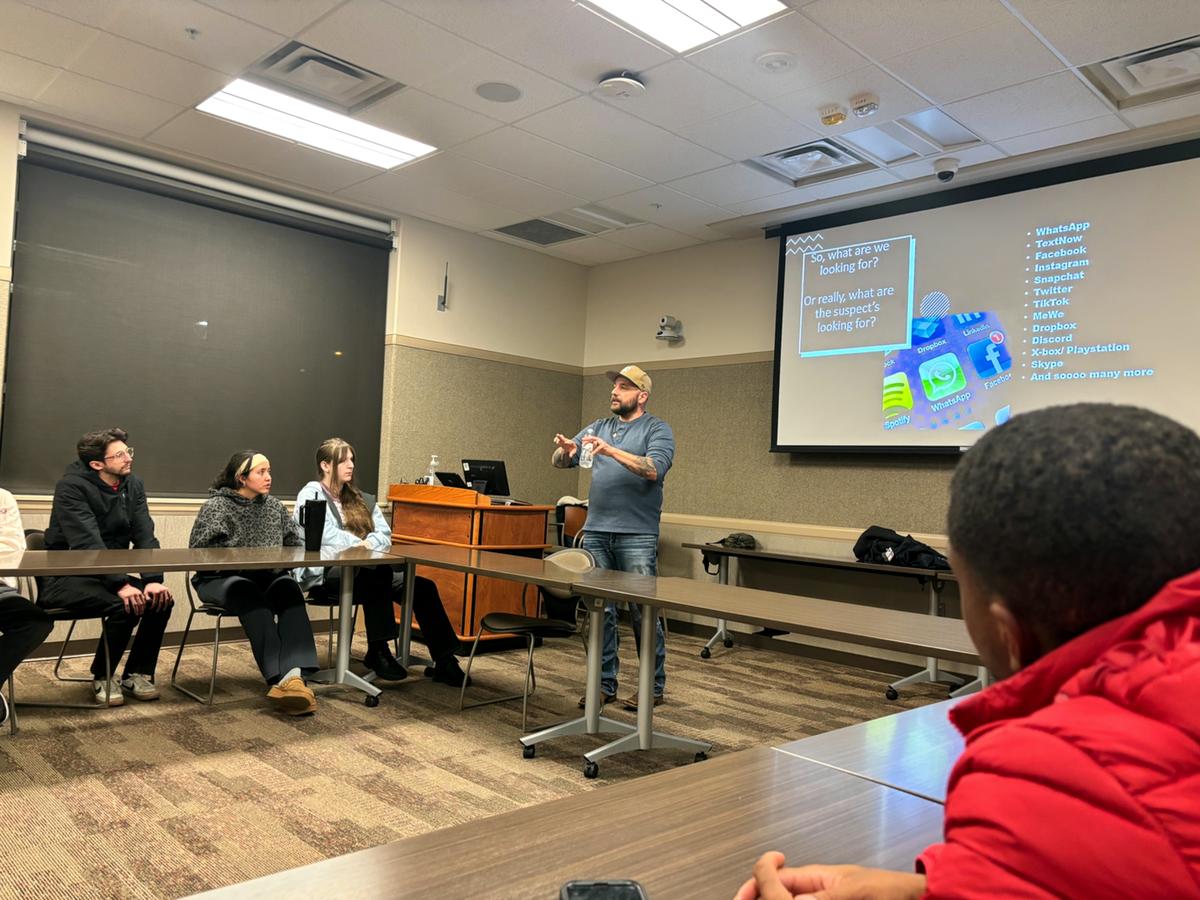
Nearly every crime leaves a digital trail. About 25 students in Computer Forensics, a 400- and 500-level course at CSU Pueblo, gathered at the Pueblo County Sheriff’s Office Emergency Services Center to learn how investigators turn a phone, laptop, or thumb drive into evidence. They sat at long tables in a training room, asking questions as they learned more about the skills required to keep communities safe.
The lesson started with a question on the screen: “So what are we looking for?”
Beneath it, sat a list of social apps showing the students where a case might begin. The list included WhatsApp, Telegram, Discord and Snapchat.
Academic research on policing, digital forensics and cybercrime has grown steadily. The field draws on law enforcement, computer science, psychology and organizational studies. The cybersecurity class brings several of those disciplines into one room, with a working investigator and a university instructor.
Mark Gonzales, the university’s information security manager and instructor for the class, has a long connection to the Sheriff’s office and the building the students were sitting in. He served as the IT project manager who built the building’s technology. He also spent 20 years working in the sheriff’s technology office as an IT manager. Gonzales parlayed that relationship to include a visit with the computer forensic units since he started the course in 2017.
The detective, Jeremy Amendola, is a High Tech Crimes Unit investigator and deputy sheriff. He grew up in the area and served as a Navy corpsman from 2009 to 2014. He came home without a clear plan.
“I didn’t know what else to do,” he told the class, so he became a patrol deputy in Fremont County. He spent nine years there and one year as a parole officer before joining the Pueblo County Sheriff’s Office in 2024. He also admitted he knew little about computers until about two years ago when he moved over to the unit.
Digital evidence now appears in nearly every case, Amendola said. His unit examines phones, computers, thumb drives, hard drives and DVR systems and sometimes the odd floppy disc. Much of the unit’s work involves child exploitation investigations through the Internet Crimes Against Children Task Force. The task force works with the National Center for Missing and Exploited Children, which sends tips to local agencies. Amendola said the center routes tips to the correct jurisdiction about 95% of the time.
The questions from students came fast. One student asked what kinds of cases the unit handles most often.
“Right now, it’s child exploitation and child sex crimes,” Amendola said. “I don’t think it’ll ever change, unfortunately. It’s the way of the world. Everyone stays inside and does terrible things on their computer.”
Another student asked how often digital evidence shows up in everyday cases compared with individual investigations. Amendola said it now appears in almost every case.
“It’s 2026, man,” he said.

Career entry follows a clear path in Pueblo County, Gonzales says. New hires start as sheriff’s deputies, and openings in the High Tech Crimes Unit come later. Other agencies hire civilian forensic examiners, Amendola added. Candidates with forensic training and certification hold a strong advantage. To ready students for this, Gonzales built the course’s final to mirror the certification exam so students get a sense of the test format before they sit for it.
Gonzales said the course falls under the cybersecurity umbrella but focuses on computer forensics, and taking students off campus to hear from someone like Amendola helps them to see real investigations rather than textbook examples.

Gonzales even expects some students to follow the detective’s path.
“If history repeats, it’ll be a few people,” he said. “After coming, students become interested in learning more about how to become a forensic investigator or forensics analyst on the criminal side of things.”