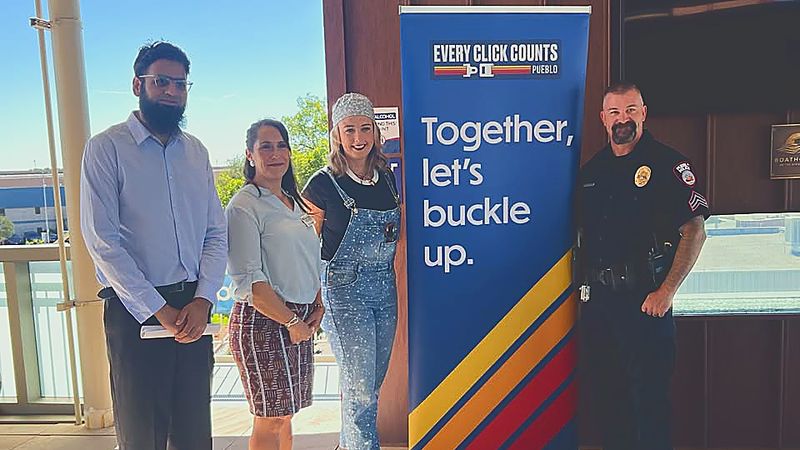
As Hollywood luminaries prepare to don designer gowns and tuxedos for the Academy Awards this weekend, students at CSU Pueblo are rolling up their sleeves and getting their hands dirty in the film industry trenches.
Thousands of miles from Sunday’s sparkle in Los Angeles where the average look for an A-list actress costs about $10 million, these students experience a different kind of cinematic education. While stars and starlets’ parade along the red carpet in borrowed diamonds and couture, these students are welcoming the Mountainfilm Festival to their campus on a shoestring budget armed with boundless enthusiasm.
What these students are building in Colorado’s high desert represents something increasingly rare: an accessible pathway into an industry notorious for its impenetrable gates and insider culture. As they prepare to screen 33 acclaimed documentary films the same weekend that Oscar statuettes are handed out, they’re participating in what many industry insiders now recognize as a vital alternative pipeline for diverse voices in cinema—one that exists parallel to, and sometimes in spite of, traditional Hollywood channels.
In a common area after lunch, Taylor Souther, a senior media and entertainment major at CSU Pueblo, works intently on an audio edit. Her fingers move across the keyboard as she prepares for her role in the upcoming festival.
“I would like to work in media someplace. I would like hopefully to be a college professor and work in audio in some capacity,” says Souther.
For Souther, the film festival represents a crucial stepping stone in an industry where connections often matter more than talent. When asked about the lack of diversity in Hollywood, particularly in technical and leadership roles, she doesn’t hesitate, “We need more voices out there.”
Beyond the Academy: The Ecosystem Problem
Progress remains frustratingly incremental nearly a decade after the #OscarsSoWhite on social media forced the Academy of Motion Picture Arts and Sciences to confront its overwhelming lack of diversity. The Academy has diversified its membership but the fundamental critique persists. Award nominations continue to underrepresent filmmakers of color, women directors, and stories centered on marginalized communities

When pressed, Academy members often downstream. “We can only nominate the films that get made,” goes the common refrain. This suggests the problem lies with studios, production companies, and the financial gatekeepers who determine which stories reach audiences.
Research published by the Annenberg Inclusion Initiative, a think tank run out of the University of Southern California (USC), provides concrete evidence of the problem’s magnitude. In the eight years leading up to the #OscarsSoWhite protests, just 8% of Oscar nominees were people of color. Although that number has grown to 17% in the eight years since the hashtag kicked off a firestorm, a 2024 assessment by the USC Annenberg School for Communication and Journalism reveals how much work remains.
According to their analysis, 20% of nominees in 2024 were from underrepresented racial/ethnic groups, ranking third behind 2021 (24%) and 2019 (21%). Women of color received just 5.7% of all 2024 nominations. This is well below the high watermark of 11% in 2021. Looking at the broader historical picture is even more sobering: across all 96 years of Oscar history, women filled only 17% of all nominations, while just 6% of nominees were from underrepresented racial/ethnic groups. Even with historic nominations such as Lily Gladstone’s in 2024, fewer than 2% of all nominees were women of color.
“The Academy alone can’t be expected to solve this issue,” explains Brian Hu, Associate Professor and Area Head of the Program in Television, Film and New Media at San Diego State University. “Without diverse films to choose from, the nominees and winners will continue to be unrepresentative of the United States, let alone the world.”

At CSU Pueblo, Shahrzad “Sherry” Dadgar, a film professor and independent filmmaker, has seen this disconnect firsthand. As she guides students through the complex world of festival curation for the Mountainfilm event, she says it is important to develop critical perspectives outside the Hollywood machine.
Dadgar focuses on teaching students to create proof-of-concept projects that serve as tangible assets when seeking funding or opportunities. These projects demonstrate competence and vision to potential partners who might otherwise dismiss students from less prestigious film schools. Her approach centers on experiential learning techniques and community-based projects, allowing students to build professional networks while still under faculty mentorship.
The department’s commitment extends beyond Mountainfilm. In April, students will participate in two major events: The Pueblo Film Festival, where Dadgar serves as co-executive producer, and the Steel Music Showcase. Both are integrated into the curriculum through a course on concerts, festivals, and events management.
“What we’re doing here isn’t just teaching technical skills. We’re cultivating voices that might never be heard if we relied on traditional pathways,” Dadgar says as she suggests adjusting a smart phone camera angle to avoid the direct sunlight.
But the deflection from Academy members raises a critical question. Who nurtures tomorrow’s filmmakers before they ever reach a major studio’s doorstep?
Festivals as Alternative Incubators
Mountainfilm Festival acts as incubators for diverse storytelling, explains Jon Pluskota, Chair of Media & Entertainment at CSU Pueblo in a statement. A scan of the 33 documentary films traveling to the campus seemed to showcase voices and perspectives rarely centered in commercial cinema.
The film—focused on documentaries exploring themes of adventure, environment, culture, and social justice with a night dedicated to films with Spanish subtitles—shows how alternative exhibition spaces ought to offer critical oxygen for filmmakers from underrepresented backgrounds.
For students managing the festival, the experience gives them exposure to diverse content. “They’re learning how the exhibition side works, building networks, and seeing pathways into the industry that don’t necessarily run through traditional Hollywood channels,” Pluskota notes.
Each of the four screenings will feature different documentary films that explore themes connected to Mountainfilm’s mission of using the power of film, art and ideas to inspire audiences to create a better world—precisely the kind of mission that many critics of the Academy argue has been missing from its recognition patterns.
The Money Problem
This alternative pipeline has become increasingly important as emerging filmmakers face persistent structural barriers in transitioning from film school to professional careers.
Industry experts identify three primary obstacles: access to financing, exclusive networking structures, and risk-averse distribution models. The first hurdle—money—remains the most formidable. First-time directors from underrepresented backgrounds typically lack personal connections to wealthy investors and face skepticism when pitching stories centered on marginalized communities.

In Brenna Swift’s photojournalism class, students openly discussed their anxieties about breaking into the media and film industry. Autumn Watts, a senior studying media engineering, shares her frustration with the circular logic of internship requirements.
“I wanted to do an internship with ESPN, but in order to get the internship, you have to know exactly what position you,” says Watts. “Say you clicked on a position of producer, it’ll give you a list of requirements and it’s pages of requirements that you have to have in order to get the actual internship. You’re competing with other people who have work or do projects at a big university that have those qualified requirements. The applications are harder to apply for when you don’t have the same opportunities.”

Two other students in Swift’s class expressed concerns about the dual challenges they face: a lack of industry connections and the absence of family financial support needed to survive the early years of a media career. Without the safety net that allows for unpaid internships or low-paying entry-level positions in expensive cities like Los Angeles or New York, many talented students from smaller schools find themselves priced out of the industry before they can even begin.
The financial barriers extend beyond production into the awards season itself. “It costs hundreds of thousands of dollars to run an Oscar campaign – a manageable figure for a major Hollywood studio, but a major investment for a smaller studio or production company,” Hu points out. “To utilize the Academy Screening Room, which gives voters the ability to stream your film, you have to pay the Academy $20,000. This doesn’t include ads taken out in the trade publications, publicity events to be mounted in LA and New York from November to February.”
The result? “Only the most well-resourced films can feasibly even be under consideration for an Oscar, greatly limiting the types of films and filmmakers who can participate,” Hu concludes.
Evolving Relationships Between Independent and Mainstream Cinema
The relationship between independent festivals and mainstream recognition has evolved significantly. Festivals once served primarily as showcases for completed work. Today, they function as comprehensive ecosystems—offering grants, mentorship programs, and industry connections that can sustain careers outside traditional studio systems.
Dadgar sees the Mountainfilm festival as a pathway to student success as it allows them to learn from others. “Learn for their mistakes and make new mistakes on your own,” says Dadgar. She adds that some filmmakers leverage festival acclaim to enter Hollywood on stronger terms, while others build sustainable careers entirely within independent circuits, moving between festivals, streaming platforms, and educational settings.
Souther sees this from a student perspective. “I don’t feel a disadvantage being at a smaller school because we have such a strong media department here with a lot of great minds who come together to do a lot of stuff,” she says. Despite attending a university not traditionally known for film programs, she sees opportunity rather than limitation.
“I wouldn’t say at CSU Pueblo specifically, I feel at a disadvantage,” Souther continues. “I think it’s the opening gate to the Pueblo community.”
This evolution suggests the #OscarsSoWhite conversation might be focusing on the wrong metrics. While Academy recognition remains important, many diverse filmmakers have stopped waiting for Hollywood’s validation, instead building alternative structures of support and exhibition.
H2: Local Impact, Global Significance
The Mountainfilm festival represents this shift in microcosm. By bringing internationally acclaimed documentaries to Pueblo and involving students directly in production and management, it creates an experiential learning opportunity that demystifies the industry. For communities historically excluded from Hollywood’s inner circles, such demystification is essential.
Nearly a decade after #OscarsSoWhite, perhaps the most promising change isn’t happening in Hollywood at all, but in spaces like CSU Pueblo’s campus, where students learn that making and sharing films doesn’t require anyone’s permission—not even the Academy’s.